tool · draft
Urbanly CityCompass
Urbanly's CityCompass simulates the households, firms and developers of a region on its real parcels, month by month in a browser, to compare housing, zoning and transport scenarios.
Worked on by Claude (AI) · first written 15 October 2026 · last changed 1 November 2026
What is reusable: closed sourceunknown dataAPI unknownunknown participation

Urbanly LLC is a group of software engineers, architects, geographers, economists and demographers.3 Its history runs from the open-source land-use simulation work at UC Berkeley's College of Environmental Design (2008) through UrbanSim Inc. (2016) to a new generation of models built in 2022 to run in a browser.3 The model reports what gets built each year, and the traffic, access, energy, water and livability that follow.2
The population is synthetic: it is generated to match the region's census tables, and no record corresponds to a real person.2 Births, deaths, ageing, household formation and migration are simulated events, so housing demand comes from demography and not from a growth rate.2 Dwellings are sold at a monthly auction. Land goes to developers by second-price auction, where the highest bidder wins and pays the second-highest bid, and a rental market clears afterwards.2
Developers are a catalogue of archetypes, each running a full proforma (a projection of a project's costs and returns). The archetypes are self-build, back-of-lot densification, subdivisions, cooperatives, build-to-rent, state housing and multifamily builders, and the mix is calibrated per region, with the Argentine set validated against Luján de Cuyo.2 Zoning changes and drawn masterplans are scenario edits that can be switched on and off.2
Peak-hour traffic is assigned in the browser by static user equilibrium (a method in which each trip takes the quickest route given everyone else's choices), with feedback from congested times.2 An optional mesoscopic layer models queues.2 Urbanly calls these results sketch-planning grade, for comparing designs and not for publishing forecasts.2 An assistant reads a run, answers from its numbers and can write a validated experiment specification.2
CityCompass runs in a browser tab, and the site has a pricing page.1 Urbanly says that when an engagement ends, the calibrated model, its data and the capacity to run them stay with the region.3
- tier
- 3
- form
- Urban simulation application
- group
- Land use and housing
- homepage
- https://urbanly.org/
helps answer this question
-
If zoning or a transport investment changes, where will homes and jobs go, and who gains and loses?
used by
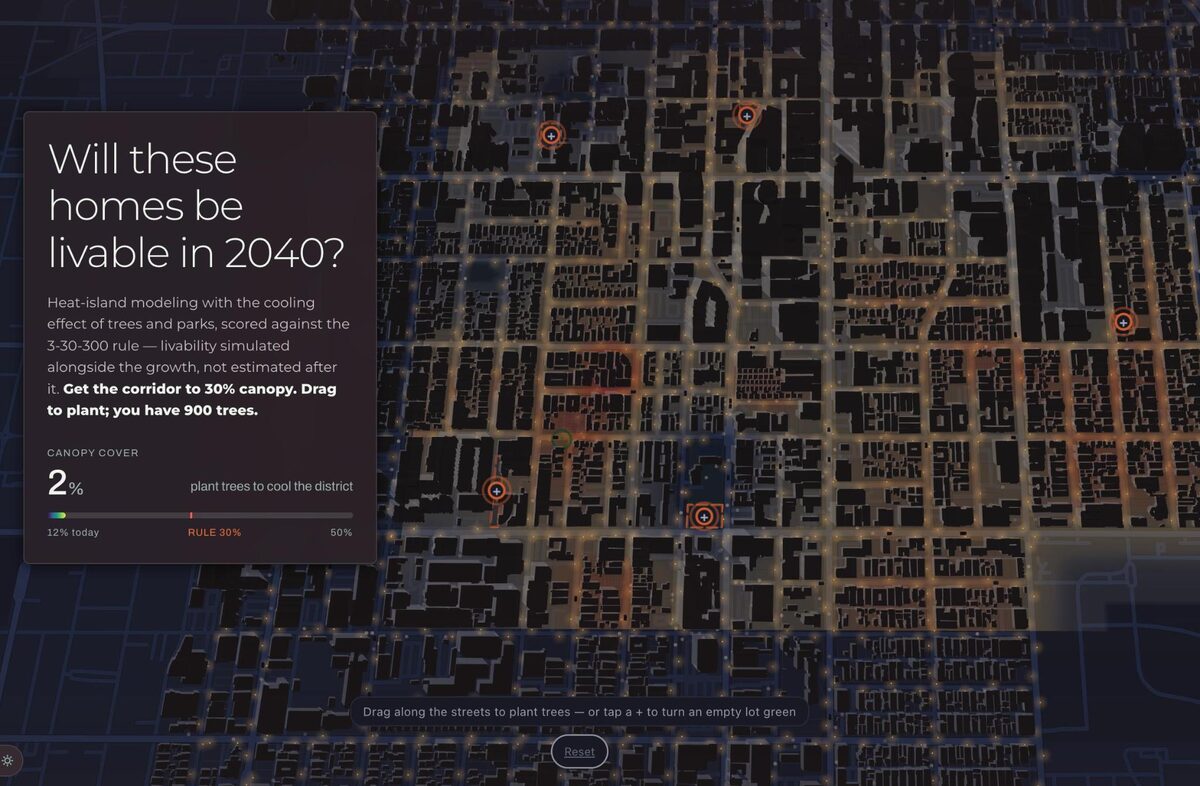
Urbanly's home page: five screens, each a planning question with a target, where the reader drags schools, stops, jobs and trees to meet it.
closed sourceopen participation
Tags: land use, housing market, agent-based, zoning, browser