Terminology
Words the field uses, and the ones we coin.

Framework from the ecological design firm Biohabitats for asking, before a data center is designed, whether it belongs in a landscape at all and how it relates to the surrounding watershed, habitat and community.

The idea that a bioregion should be organised around the relationships that sustain life in a place, such as a shared water system, rather than around a boundary drawn on a map; argued by Indy Johar and related to the rights-of-nature movement for rivers.

The aim of predictive models of land, water, law and policy that ordinary people can run, question and argue with, open to the public and not reserved for planners, companies and agencies.
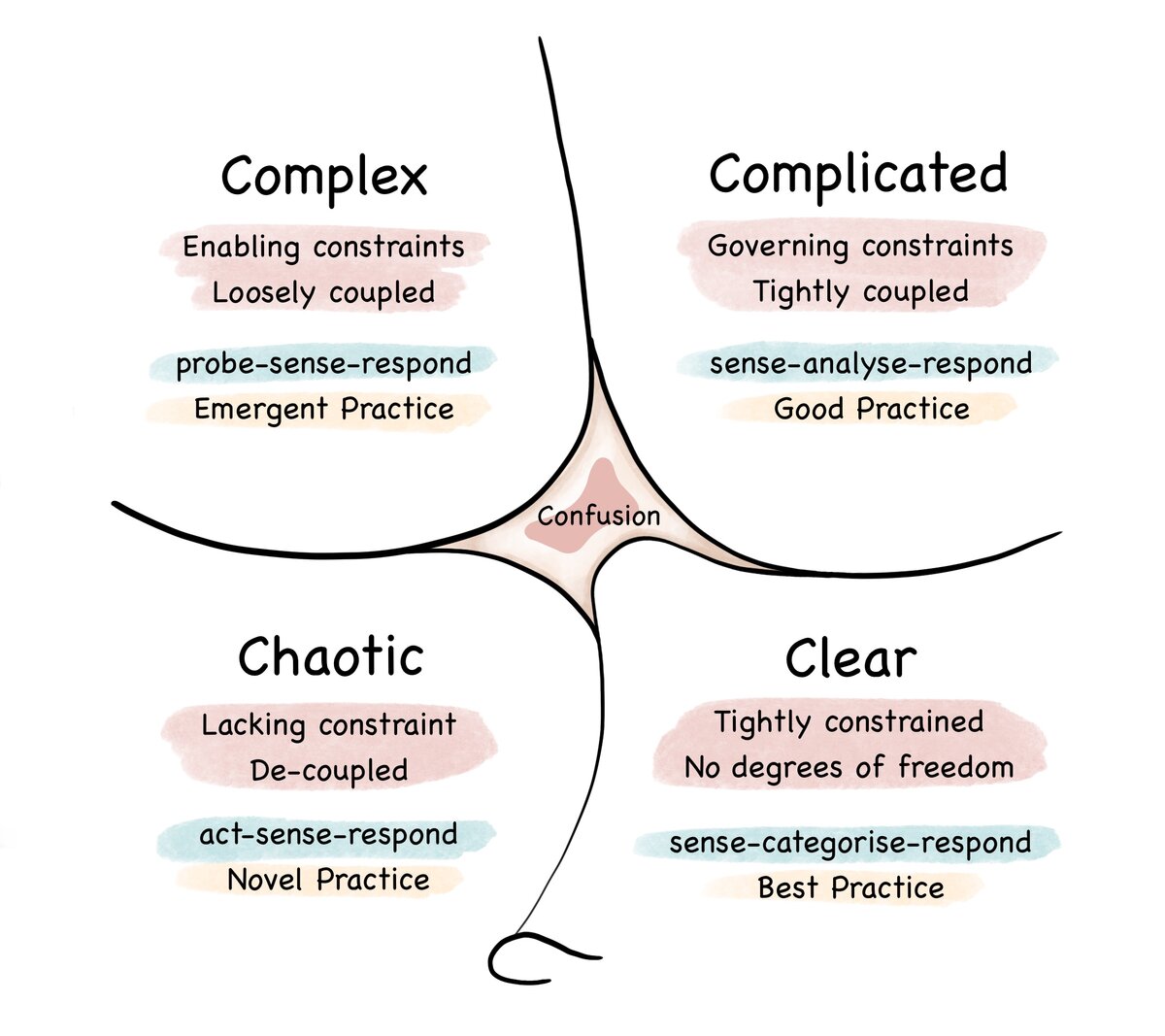
Dave Snowden's framework of five domains (clear, complicated, complex, chaotic and confused), each with its own mode of action and its own limits on prediction.
-
A computational representation of a real object, place or system, linked to information about its real-world counterpart.
-
Patient twins in medicine, language-model agents built from interviews with single people, and simulated populations built from the census or from language models.

A climate model with the living world wired in. The carbon that plants and oceans take up feeds back on the climate that drives them, so the model runs on emissions, not on a prescribed CO2 curve.
-
A way of describing the condition of a forest by its composition, structure, processes and stability, assessed with a framework from the Primary Forests & Climate Program at Griffith University.
-
The study of possible futures in order to act now, also called futures studies or strategic foresight: where it is taught, its roots in anticipatory democracy, and why it avoids the word predict.
-
Deliberate large-scale intervention in the climate to counter warming, by reflecting sunlight or by removing carbon dioxide.
-
A proposal for a foundation model trained on observations of the Earth itself, estimating the planet's current state and simulating how it responds to intervention.
-
The set of things, kinds and relations a model admits: the decision about how to cut a continuous world into parts that can be named, counted and simulated.
-
Two words for the world's crises taken together: what each means, who uses them, and the few places they touch the modelling of places.
-
Blue Green Future's accounting framework that counts living ecosystems as productive infrastructure in GDP and on sovereign balance sheets.
-
The laws and legal designations laid over land and water that decide what may happen in a place: zoning, parcels, permits, environmental review, protected areas, flood zones and water rights.
-
A made-up set of households and people for a place, built so that its totals and mixes match the census, letting a model hold everyone without holding anyone's real records.
-
A threshold past which a place or system shifts abruptly to another state, and the warning signs that may come before the shift.
-
A biodiversity-credit protocol from Ecosystem Regeneration Associates (ERA) in Brazil that pays landholders for keeping an umbrella species and its habitat in good condition, checked by monitoring and external audit.
-
African Parks' unit of conservation performance, one square kilometre in which ecological integrity has been kept or improved over a year, used as the basis for outcomes-based funding.
-
A phrase with three unrelated meanings: a system dynamics model of the globe, a neural network's learned simulation of an environment, and loosely any model of the Earth.
-
A proposed social-science counterpart to Earth System Science, set out in The Anthropocene Crisis (Cambridge University Press), edited by Mathias Albert and Barry Buzan.