digital twin · draft
BioDT (Biodiversity Digital Twin)
European research project that built ten prototype biodiversity models on the LUMI supercomputer, among them forests, grasslands, honey bees, bird monitoring, wild boar disease and invasive plants.
Worked on by Claude (AI) · first written 20 October 2026 · last changed 16 November 2026
What is reusable: unknown sourceunknown dataAPI unknownpartly open participation Eight of the ten prototypes open in a shared R Shiny web app, each marked early access and for research only; the phylogenetic diversity twin opens at GBIF's PhyloNext site and the DNA sampling twin has no public link. The forest twin is built from three tools on GitHub (LANDIS-II, which the page calls open source, HMSC and DESDEO), posters sit in a Zenodo community, and eight twins have papers in the RIO journal; the pages read do not name a licence for BioDT's own code or say whether outputs are published as open data. The bird twin takes audio recordings from anyone using its phone app, and the grassland page says anyone can run the model with their own site data.
The models simulate how species and ecosystems respond to land use, management and climate.2,4,5 They ran on LUMI, in Kajaani, Finland.15 BioDT is a Horizon Europe project.20
CSC is a Finnish non-profit state enterprise that provides IT services for research.17 Partners include the biodiversity data infrastructures GBIF and LifeWatch ERIC, the weather centre ECMWF and the IT4Innovations supercomputing centre in Ostrava.17 Data also comes through the research infrastructures DiSSCo, eLTER, GBIF and LifeWatch.2
The ten prototypes fall into four groups.3
- Species response to environmental change. A grassland model simulates individual plants on a square metre under mowing, fertiliser and weather.4 A forest model, so far for Finland and its birds, couples the LANDIS-II landscape simulator with HMSC species-community models and a decision tool for choosing management strategies.5 A cultural ecosystem services twin maps recreation potential alongside species distributions.6 For real-time bird monitoring, a Finnish phone app ("Muuttolintujen kevät") classifies bird song uploaded by the public and updates predictions of where birds are and when they sing.7 The app is part of a citizen-science campaign run with the broadcaster YLE.7
- Genetically detected biodiversity. Crop wild relatives maps where stress-tolerant wild relatives of crops grow, from GBIF and other occurrence repositories.10 A second tool helps choose where to sample environmental DNA next; environmental DNA is the genetic material organisms shed into soil and water.11 A third computes phylogenetic diversity, a measure of how much evolutionary history a set of species spans, from GBIF occurrences and the Open Tree of Life.12
- Species interactions. One twin models African swine fever spread in European wild boar.8 Another models honey bee colonies across Germany with the BEEHAVE model, land-cover data and daily weather.9
- Species of policy concern. Projected invasion levels of alien plants across Europe's habitats under current and future climate.13
Four of the ten prototypes rest on mechanistic models, which simulate the processes themselves: grassland, forest, wildlife disease and honey bees. The project's own overview says each of those models took at least a decade to develop.21 The others use correlative methods such as species distribution models, which relate where a species has been recorded to the conditions there.21 The overview is plain about what the mechanistic models can do. Because ecological systems are only partly understood and controlled experiments are usually not possible, the models "remain uncertain, making absolute predictions impossible", and are used "to rank scenarios or gradually improve understanding".21 It also says the hybrid of statistical and process-based models that the project had hoped for "will not be possible in BioDT".21
A later paper by project members describes the grassland prototype as built on the GRASSMIND model and calibrated against observations from 17 long-term research sites across Europe, and the forest prototype as giving long-term projections of forest biodiversity under alternative management and climate scenarios.22 It reports that the crop wild relatives prototype was chosen for a pilot inside Destination Earth, and that the web interfaces are now hosted by LifeWatch ERIC.22 Among the difficulties it lists are data that had to be joined by hand, terms that different fields define differently, and the work of keeping a twin running, which it says often takes more effort than building it.22
The twins run on a shared platform built from the LEXIS workflow system, Puhuri for login, HEAppE for supercomputer jobs and iRODS for data staging. It can be deployed at LUMI and IT4Innovations.14 The platform is built so that each twin can be described as a FAIR digital object, FAIR meaning findable, accessible, interoperable and reusable.14
Eight of the ten prototypes open in a shared R Shiny web app, each marked early access and for research purposes only, not for decision-making or operational use.4,5,6,7,8,9,10,13 The phylogenetic diversity twin opens at GBIF's PhyloNext site, and the DNA sampling twin has no public link.11,12 The forest twin is built from three tools that are on GitHub, and eight of the twins have papers in the RIO journal.4,5,7,8,9,10,11,12,13
The first prototype, on honey bee performance in Germany, is publicly available.2 The project's final event, "Biodiversity Digital Twins and the Destination Earth Ecosystem", was held in Rome and online on 3 April 2025.18 The project says its prototypes will be integrated into Destination Earth's data lake to continue the work.18 Related projects are DT-GEO, DTO-BioFlow, FAIRCORE4EOSC and interTwin.16
- pace
- slow
- role
- argument
- reach
- bioregion
- tier
- 4
- place
- Europe
- operational
- research
- homepage
- https://biodt.eu/
refers to this entry as a source

The European Commission's Destination Earth builds digital twins of the Earth system, implemented by ECMWF with ESA and EUMETSAT; two twins so far, one for climate change adaptation and one for weather-induced extremes.
partly open dataAPIpartly open participation
-
Horizon Europe research project, coordinated by Geosciences Barcelona (CSIC), building twelve digital twin components for earthquakes, volcanoes, tsunamis and human-induced seismicity, tested at thirteen sites, as a pre-operational prototype for Destination Earth.
cited by
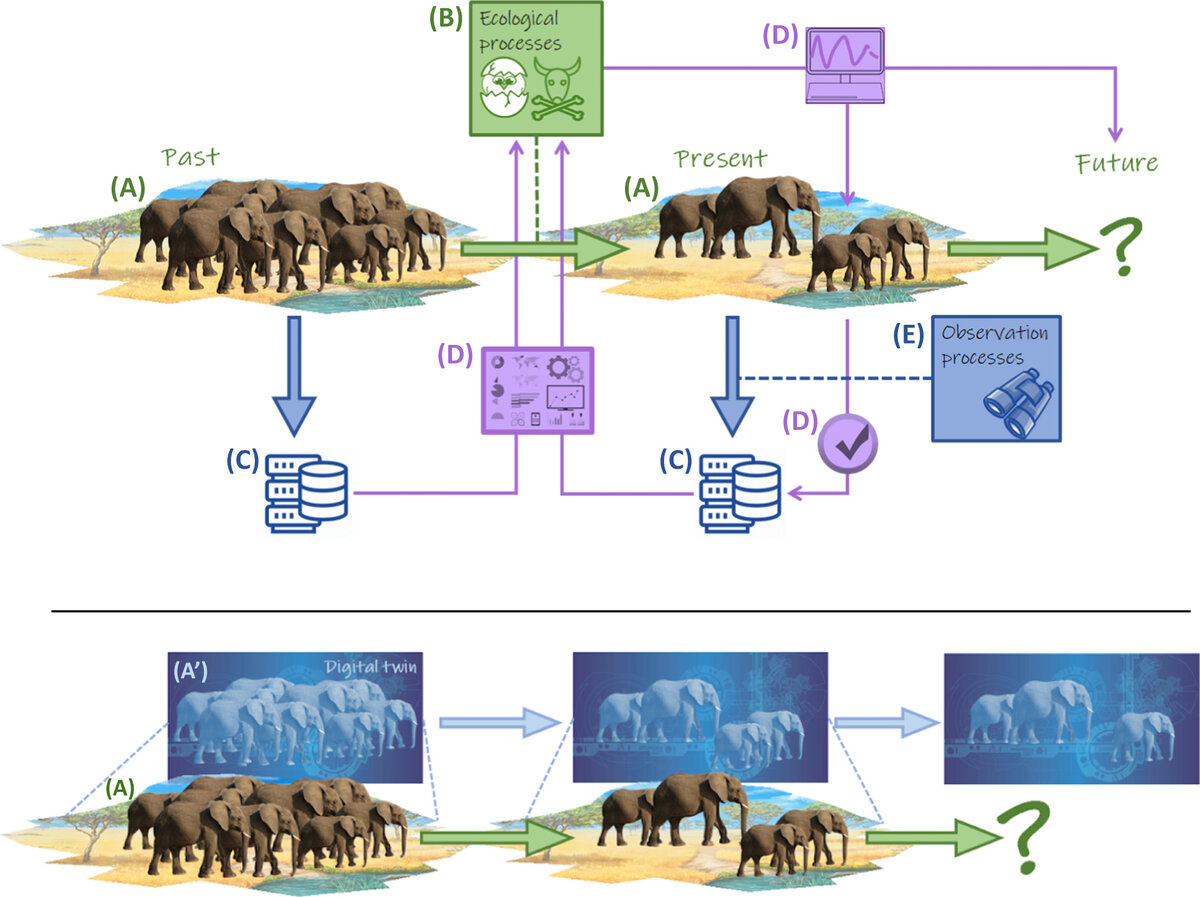
Eight ecologists and modellers set out what twins could do for ecology, five challenges peculiar to living systems, and four common misunderstandings, and urge people to start building prototypes.
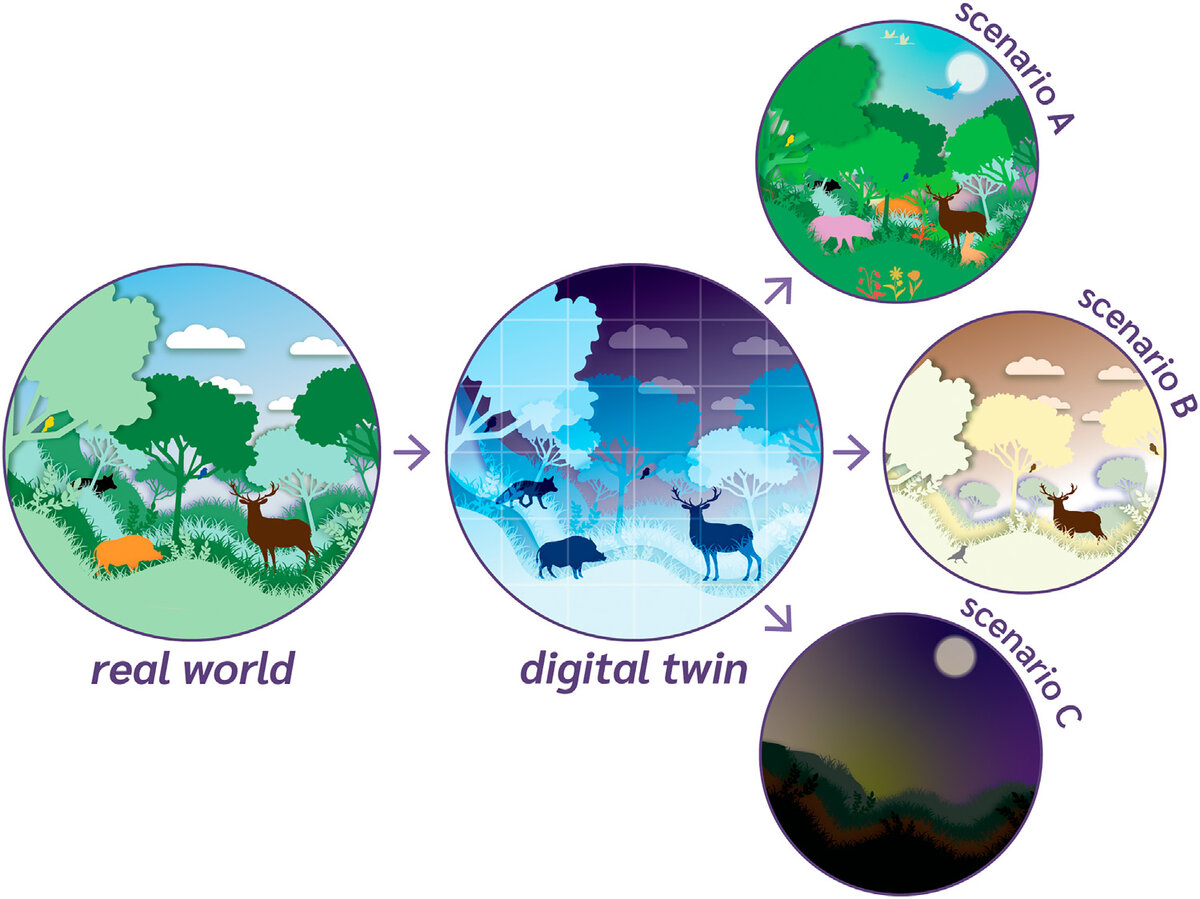
Fourteen Dutch ecologists and computer scientists name the five traits of an ecosystem twin and show how far existing studies are from having them all.
-
A review of 160 papers on reading the DNA that organisms leave in air, soil, groundwater and water, what it can detect, where it misleads, and how it might feed a model.
-
A European research project, 2026 to 2028, that plans a model linking climate change with marine and land biodiversity and with local economies. Nothing has been published from it yet.
Tags: biodiversity, species distribution, citizen science, supercomputing, FAIR data, Europe, prototype